 blog
Cleaning Business Near Me: How to Choose a Pro
Table of Contents
- What to Look for in a Cleaning Business Near Me
- House Cleaning Cost: What Drives the Price
- The Cleaning Service Checklist: Inclusions and Exclusions
- One-Time House Cleaning vs. Recurring House Cleaning Service
- Deep Cleaning, Carpet Cleaning, and Specialty Services
- Service Area and Local Availability: Booking a Local Cleaning Service
- How to Compare Cleaning Businesses and Get a Free Estimate
- Frequently Asked Questions
Last Updated: October 21, 2026
What to Look for in a Cleaning Business Near Me
Searching for a cleaning business near me usually returns a long list of names with little to separate them. The right choice comes down to four things: verified insurance, a documented vetting process, consistent service standards, and reviews that describe repeat visits, not just first cleans.
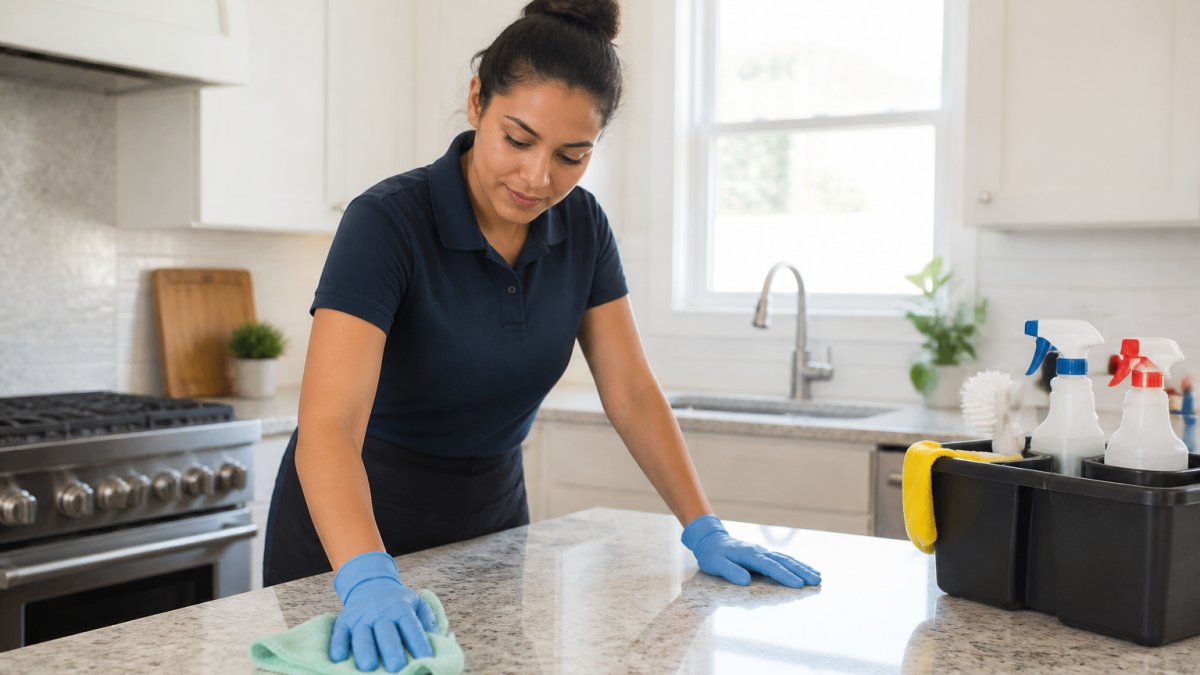
Here is the part most guides skip. A cleaning company is only as good as its worst-trained employee, because that is who shows up on any given week.
Insurance, Bonding, and Background Checks
A legitimate cleaning business carries general liability insurance and a surety bond, and runs background checks on every cleaner who enters a client's property. Ask for proof of coverage in writing before the first visit.
General liability insurance covers accidental damage to your home, such as a broken fixture or a scratched floor. A surety bond protects you if an employee steals from the property.
Reviews, Customer Ratings, and Service Quality
Reviews reveal a pattern only when you read them in volume. Look for comments about consistency across multiple visits, punctuality, and how the company handled a complaint.
Check where reviews live. Google and Facebook reviews are harder to curate than testimonials on a company's own site. Read the negative ones first, and note whether the owner responded with a fix or an excuse.
House Cleaning Cost: What Drives the Price
House cleaning cost depends on square footage, the number of bathrooms, cleaning frequency, and the level of service, not on a single flat rate. Most providers quote after asking about the home, which is why two estimates for the same house can differ.
Most residential providers price in one of three ways:
- Flat rate per visit. The provider sets a price based on bedrooms, bathrooms, and frequency. This is the most common model for recurring service because it is predictable for both sides.
- Hourly rate. Common for one-time and deep cleans where condition is unknown. The final bill depends on how long the crew is on site, so ask for an estimated hour range in writing.
- Room or task pricing. Common for add-ons and small jobs. Each room or task carries its own line item.
The variables that move the number most:
- Frequency. Recurring visits cost less per clean than one-time jobs, because the home stays maintained. A weekly or biweekly plan typically carries the lowest per-visit rate; a monthly plan sits in the middle; a one-time clean is priced highest per visit.
- Condition. A first-time deep clean on a neglected home takes longer than a routine refresh, and many providers require a deep clean as the first visit on a recurring plan.
- Add-ons. Inside the oven, inside the fridge, baseboards, and interior windows are usually priced separately. Ask for each add-on as a line item so you can compare across providers.
- Access. Homes with pets, heavy clutter, or multiple levels take more labor and can carry a surcharge.
- Supplies and equipment. Some providers include supplies in the quote; others pass the cost through or expect the homeowner to supply products. Confirm which before comparing totals.
A practical way to compare: build a one-page worksheet with columns for base price, pricing model, included tasks, add-on prices, supplies, and cancellation terms. Fill it in for three providers using the same scope. The provider with the clearest line items is usually the one easiest to hold accountable, even if it is not the lowest number.
Watch for these pricing red flags:
- A quote given over the phone with no questions about the home.
- A price far below the others with no written scope.
- Add-ons that appear only after the first visit.
- A recurring discount that disappears if you skip a visit.
None of these is automatically disqualifying, but each one should prompt a written clarification before you book.
The Cleaning Service Checklist: Inclusions and Exclusions
A cleaning service checklist is the document that prevents disputes, because it states exactly what gets cleaned and what does not. Request one from each provider and compare them side by side before you sign anything.
Most standard cleans include dusting of reachable surfaces, vacuuming of floors and carpets, mopping hard floors, bathroom sanitizing, and kitchen wipe-downs. Common exclusions are interior windows above reach, inside appliances, garages, and heavy decluttering.
| Task | Standard Clean | Deep Clean | Notes |
|---|---|---|---|
| Dust reachable surfaces | Included | Included | Above-reach areas extra |
| Vacuum and mop floors | Included | Included | |
| Bathroom sanitizing | Included | Included | Grout detail in deep |
| Inside oven and fridge | Excluded | Often included | Confirm per provider |
| Baseboards and vents | Spot only | Included | |
| Interior windows | Excluded | Add-on |
One-Time House Cleaning vs. Recurring House Cleaning Service
One-time house cleaning suits move-ins, move-outs, events, and seasonal resets. A recurring house cleaning service suits households that want a maintained baseline without thinking about it. The trade-off is flexibility versus consistency.
One-time cleans are priced higher per visit and often carry a minimum charge. Recurring plans cost less per clean and build in a routine, so the cleaner learns the home and spots problems early.
When a Recurring House Cleaning Service Pays Off
A recurring plan pays off when the mess is predictable: a busy household, a rental property with regular turnovers, or an office with steady foot traffic. It also pays off when you value the same standard every visit rather than a one-off deep result.
The honest limitation: recurring plans lock in a schedule and often a cancellation window. If your needs change month to month, a one-time deep clean with occasional follow-ups may fit better.
Deep Cleaning, Carpet Cleaning, and Specialty Services
Deep cleaning goes beyond the routine list: baseboards, vents, grout, appliance interiors, and the buildup that a standard clean leaves behind. Carpet and upholstery cleaning, drapery cleaning, blind cleaning, and hardwood floor cleaning are usually separate specialty services with their own methods and pricing.
Not every provider offers these in-house. Some subcontract carpet cleaning, which affects both accountability and scheduling. Ask who actually performs the work, and then verify the credentials of whoever shows up, whether employee or subcontractor.
How to Vet Specialty Providers
Specialty work carries more risk than a standard clean: hot-water extraction on carpet, solvents on upholstery, and moisture near hardwood can cause damage if done wrong. That makes insurance and bonding checks more important, not less. Use this checklist for each specialty provider:
- Certificate of general liability insurance provided in writing, with the policy current and the business name matching the quote.
- Surety bond confirmed, which protects you if an employee steals from the property.
- Background check process described for every worker who enters the home, including subcontractors.
- Written method statement for the specific service, such as the extraction method for carpet or the product line for upholstery.
- Product safety information, including whether solvents are low-VOC or suitable for households with sensitivities.
- Clear statement of who is liable if damage occurs, and how a claim is filed.
- Drying time and re-entry guidance for carpet and upholstery work.
In-House vs. Subcontracted Specialty Work
In-house teams carry the company's insurance, training, and quality standard, so accountability stays with the business you hired. Subcontractors may carry their own coverage, which means you should verify it separately rather than assume the booking company's policy extends to them. Ask directly: "Is the person doing this work your employee, and are they covered by your insurance?" Get the answer in writing.
Green and Non-Toxic Considerations
If anyone in the household has asthma, allergies, or chemical sensitivities, ask for the product list before booking specialty work. Look for low-VOC or fragrance-free options and confirm whether the provider will use your preferred products on request. A provider that cannot name its products is a provider that cannot answer the sensitivity question.
Service Area and Local Availability: Booking a Local Cleaning Service
A local cleaning service should confirm its service area before quoting, because travel time affects scheduling and reliability.
Local availability matters more than most people expect. A provider that is stretched thin across a wide area cancels more often.
When you book, confirm three things in writing: the arrival window, the cancellation and rescheduling policy, and the name of the person who will clean.
How to Compare Cleaning Businesses and Get a Free Estimate
Comparing cleaning businesses takes one afternoon if you use a consistent scorecard. Request a free estimate from at least three providers, give each the same scope, and score the answers rather than the sales pitch.
Use this checklist for each provider:
- Certificate of insurance and bonding provided in writing
- Background check process described
- Written checklist of inclusions and exclusions
- Itemized estimate for the same scope as the others
- Clear cancellation and rescheduling policy
- Satisfaction guarantee stated in the contract
- Named contact and confirmed arrival window
- Reviews read across multiple visits, not just one
The Federal Trade Commission's consumer guidance on hiring service providers is a useful reference for what a fair contract should disclose. For background on how professional cleaning standards are defined, the ISSA, the worldwide cleaning industry association publishes industry guidance worth reviewing.
At Poe Professional, we built our residential service around the gaps this checklist exposes: rotational deep cleaning systems so quality holds month after month, personalized cleaning kits, and a cross-contamination prevention standard for homes and clinics alike.
Frequently Asked Questions
How much should a cleaning business charge per hour?
Hourly rates vary by region, home size, and the scope of the job, so ask each local cleaning business for a free estimate rather than relying on a single national figure. A standard clean, a deep clean, and a move-out clean carry different labor loads, and providers often price by square footage or flat rate instead of the hour. Request a written quote that lists what is included, then compare quotes side by side. Poe Professional provides estimates based on your specific home and service type.
What should I look for when choosing a house cleaning service?
Check four things: proof of insurance, a written cleaning service checklist, a clear satisfaction guarantee, and recent customer reviews. Ask whether cleaners are employees or subcontractors, how background checks are handled, and what the cancellation policy is. Confirm the provider serves your address and can commit to a consistent schedule. A reliable service will answer these questions directly and put the details in writing before you book.
Should I hire an insured cleaning company?
Yes. Insurance protects you if a cleaner damages property or is injured in your home. Ask for a certificate of insurance and confirm the policy is current. Bonding adds coverage for theft, and background checks speak to who is entering your home. An uninsured independent cleaner may cost less upfront, but you absorb the risk. Poe Professional is fully insured, which is one of the first things to verify with any local cleaning service you consider.
What is usually included in a standard house cleaning?
A standard clean typically covers dusting surfaces, vacuuming carpets and floors, mopping hard floors, cleaning bathrooms, wiping kitchen counters, and emptying trash. Deep cleaning adds baseboards, inside appliances, grout, blinds, and other buildup areas. Carpet cleaning and upholstery cleaning are often separate services. Ask for a cleaning service checklist in writing so you know exactly what is included and what costs extra before the first visit.
The hardest part of hiring a cleaner is not finding names. It is trusting that the standard holds on visit ten as it did on visit one. That consistency is exactly what we built Poe Professional to deliver, with rotational deep cleaning systems, personalized cleaning kits, and a cross-contamination prevention standard on every job. Get started with Poe Professional by completing our client intake form, and we will confirm your service area and provide a written estimate for your home or facility.